
3D printed vase to your own size
Pick the purpose, shape and size. The preview changes at once.
Material and quantity
On the next page you pick the colour, the material and the print settings and ask for the price. Nothing is ordered or paid yet.
A printed vase may not be watertight: microscopic gaps can remain between layers. For cut flowers put a glass inside or seal the inside with varnish. A pot with drainage lets water through on purpose, hence the saucer.
Which shapes the vase takes, what a print costs and whether it holds water
The tool makes a vase or a plant pot cover from the height and the diameters you enter: height 40 to 300 mm, top and bottom diameter 30 to 250 mm. You pick one of four shapes (a narrow neck, bulging, a straight cone or a tulip) and a smooth, ribbed or spiral surface; for the ribbed and the spiral ones you set the number of ribs, the depth of the grooves and the twist, and choose sharp or round waves. On the narrow-neck shape you move the narrowing up or down and can have up to three of them. A pot cover can have drainage holes in the bottom and a separate saucer. The wall and the bottom are 1.6 mm by default (wall 0.8 to 4 mm, bottom 0.8 to 5 mm). The preview shows the real outer size, because bulging shapes and ribs are wider than the diameters you enter.
An example from the production calculator (18 October 2026, PLA+): a smooth narrow-neck vase 160 mm high weighs 76 g, prints in 1 h 57 min and costs 190 CZK (about 8 EUR) from us; a 180 mm spiral vase with 18 ribs weighs 80 g, prints in 5 h 7 min and costs 280 CZK (about 11 EUR); a ribbed 120 mm pot cover with drainage weighs 99 g, prints in 3 h 45 min and costs 260 CZK without the saucer, all without delivery. The cover with its saucer side by side measures 287 mm, so the calculation prints it on two beds or you make it smaller. A printed vase need not be watertight; for cut flowers put a glass inside. You download the model free as an STL or a project for your printer.
Before you order
How much does a vase cost from you?
A smooth 160 mm vase 190 CZK, a 180 mm spiral one 280 CZK, a ribbed 120 mm pot cover 260 CZK (PLA+, without delivery, calculation of 18 October 2026). The calculation shows the price of your vase before you order anything; grams and minutes decide, for spirals mainly the minutes.
Which filament for a vase?
For spiral and ribbed vases glossy PLA Silk, on which the ribs play with the light; for smooth ones a matte filament that hides the layers. For a pot cover, which gets wet, choose PETG. You pick the colour from the spools we have in stock right now.
How long do printing and delivery take?
A smooth 160 mm vase prints in under 2 hours, a 180 mm spiral one in 5 hours. We dispatch on the day the print ends, on working days, and Packeta usually delivers within 1 to 2 working days in the Czech Republic (to a pickup point €4.00).
How do I print the vase at home?
Upright, without supports; the downloaded project has the wall and the bottom as designed. The STL is a solid body, so you can switch your slicer to vase mode with a single wall, which prints faster and quieter but holds water worse. Print tall vases with a brim so that they do not come off the bed.
How do I measure a pot for a cover?
Measure the outer diameter of the pot at the top rim and its height, add 5 to 10 mm of play to the diameter and enter it as the top diameter of the cover; the bottom diameter a little smaller to follow the shape of the pot. The saucer is computed by itself.
Do I need an account?
Not for the design or the download. You need one only when you have the vase printed by us; that is paid from credit topped up by card.
Who it is for
Dried flowers for the table
A 180 mm spiral vase with a narrow neck in PLA Silk; for dried flowers it need not hold water.
A pot cover for the flat
A ribbed 120 mm cover with drainage and a saucer in PETG, the diameter of the pot plus 5 mm.
A set of three vases
Smooth vases of 120, 160 and 200 mm in the same shape and one colour for a shelf or as a gift.
How it came out
Real prints from our farm that customers had made with this tool.
-
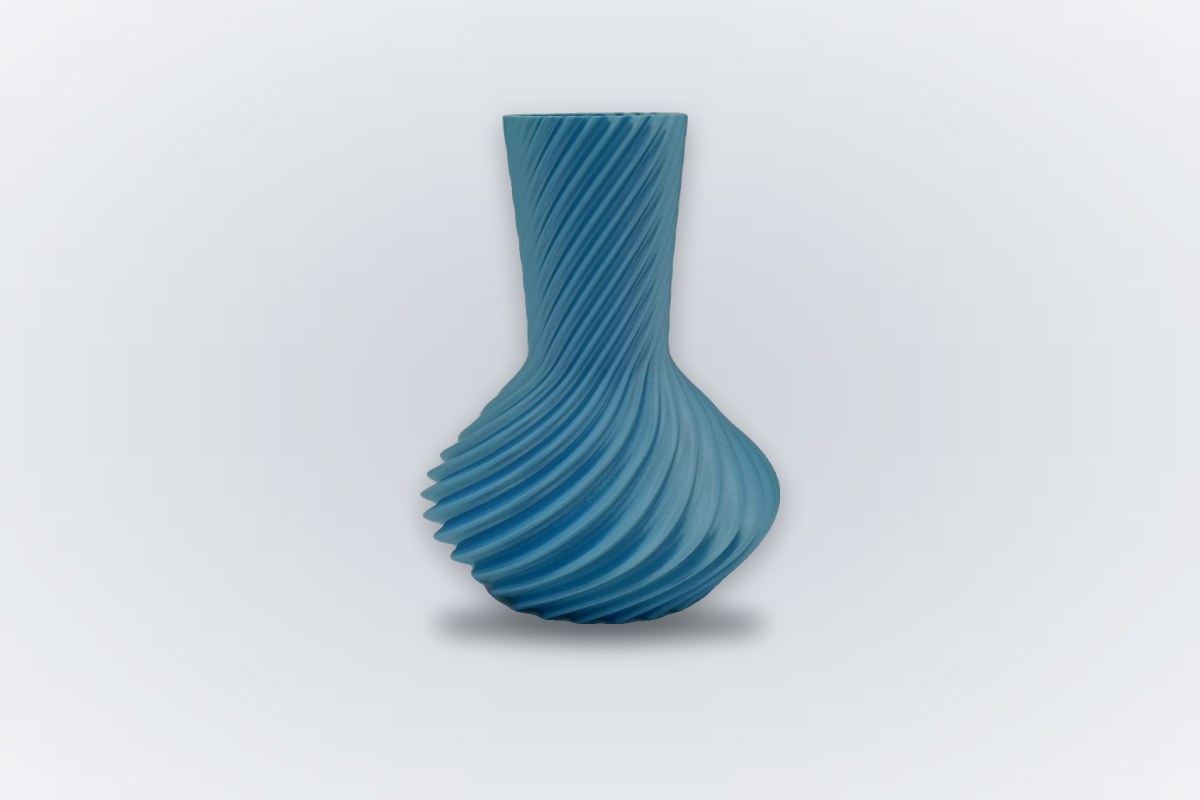
PLA Silk · 22 Oct 2026

How it works
- Choose the purpose and the shape. Pick a vase or a pot cover and one of four shapes. You can start from the preset "Spiral", "Ribbed", "Smooth" or "Plant pot".
- Enter the size. Set the height, the top diameter and the bottom diameter. For a cover measure the pot you will put in it and add some play.
- Tune the surface. For a ribbed or spiral surface set the number of ribs, the depth of the grooves and the twist. The tool warns when the wall between the grooves would come out too thin.
- Order the print or download. Check the preview and go on to the exact price with "Continue". Or download the model free for your own printer.
What the tool can make


Common questions
Does a printed vase hold water?
Not necessarily. Microscopic leaks can remain between the layers. For cut flowers put a glass or a test tube inside the vase, or seal the inside with varnish; for dried flowers and as a pot cover you need not bother.
How big a vase can I design?
The height from 40 to 300 mm, the top and bottom diameter from 30 to 250 mm. A tall or wide vase does not fit every printer; the bed of our farm is 250 × 250 mm and the calculation says so.
Why does a spiral vase cost more than a smooth one?
Ribs and twist add surface and the printer follows a winding path: the 180 mm spiral vase printed in 5 h 7 min, the smooth 160 mm one in 1 h 57 min at a similar weight. The price comes from grams and minutes, hence the 90 CZK difference.
What are the drainage holes and the saucer for?
With a pot cover, excess water drains through the holes in the bottom and the saucer catches it. The saucer is a separate part and the tool computes its diameter from the bottom.
Why is the vase wider than the diameters I entered?
The diameters apply to the top rim and the bottom. The narrow-neck and the bulging shape widen between them and the ribs add more millimetres. The preview shows the real outer size.
How thick is the wall, and can it print in vase mode?
The wall and the bottom are 1.6 mm by default; the wall goes from 0.8 to 4 mm, the bottom from 0.8 to 5 mm. The downloaded STL is a solid body, so in your slicer you can print it in vase mode as a single wall too; we print the wall as designed with infill, which holds water better.
Where next
Similar tools
Looking for something else? See all Tools