Printables.com
Moon Lamp (Commercial Use Allowed)
🏭 100+ tiskáren
·
across Czechia
·
⏱ pay after printer accepts
Model author: Artificial World
·
original on Printables.com
Description
Please read the entire text before printing! I often make the mistake of not doing so. If you like the model, consider supporting my future projects: https://boosty.to/artificialworld/donate.
1. Model:
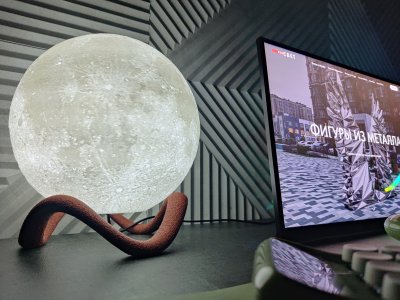
Moon
Appr. diameter: 210 mm
Surface: Moon Displacement Map + Moon Color Map (Lithophane). Both from NASA
Adapter
Important note: I use a tiny USB light (link to Amazon USB light) with a USB extension cable (link to Amazon USB extension cable), so that my adapter only needs a hole for a cable. You may need to look at "LightPlacement (BetterFit).stl" to edit it according to your own needs
Opening diameter: 58 mm. This means that you can fit a cylinder with a 58 mm diameter inside the lamp
Connection type: Bayonet Connection
Maximum slope of overhangs: 45 degrees. Thus, you will face no issues with overhangs
Tolerances were tested thoroughly, so the adapter fits easily
Stand
Appr. width: 180 mm
Appr. height: 58 mm
2. Printing Instructions:
I printed the Moon Lamp with a Flashforge Adventurer 5M with 0.4 mm nozzle
Moon
Recommended material: Basic white PLA
Layer height: 0.2 mm
Sparse infill density: 100%
Brim type: Outer and inner brim
Brim width: 65 mm. You can print it without a brim, but I had a problem when the printing was almost finished, so next time I set the brim to maximum
Adapter ring modifier (optional, but saves a lot of material):
Sparse infill density: 5%
Sparse infill pattern: Grid
Everything else is default orca slicer settings.
Adapter Halves
Recommended material: Basic white PLA
Layer height: 0.2 mm
Sparse infill density: 5%
Sparse infill pattern: Grid
Optional (Improves adhesion to the plate):
Brim type: Outer brim only
Brim width: 5 mm
Everything else is default orca slicer settings
Stand
Recommended material: Brown PLA with 15% wood
Layer height: 0.2 mm
Sparse infill density: 5%
Sparse infill pattern: Grid
Position below plate: 1.05 mm. This increases the bottom surface area
Fuzzy skin: Contour
Fuzzy skin noise type: Classic
Fuzzy skin point distance: 0.5 mm
Fuzzy skin thickness: 0.5 mm
Top surface floor ratio: 1.7. Adds a fuzzy texture to top surfaces
Top surface pattern: Hilbert Curve
Enable support: true
Support type: Tree (auto)
Optional (Improves adhesion to the plate):
Initial layer height: 0.4 mm
Initial layer speed: 25 mm/s
Everything else is default orca slicer settings
3. License:
Allowed Use
The license for this model gives you complete freedom to use it in any way you like, as long as you provide attribution.
Attribution
The Wavy Stand was created by @Michael1215_742401, who improved on the original version by @cookingfat. The idea of using a wavy stand with a lithophane moon also belongs to @cookingfat.
Original Creation (Do Not Report This Model)
If you have any questions, write me an email: artificialworld747@gmail.com. Or message me.
If you plan to report the model, see this discussion: https://www.printables.com/model/1481473-moon-lamp-commercial-use-allowed/comments/3061773
All content not listed in the "Attribution" section was created by me from scratch. I have evidence to prove this, including screenshots, videos, and original files. An important difference from many other moon lamp models is that I prioritize the displacement map over the color map for the outer surface. I also cancel the displacement map's effect on color by applying it to both sides of the wall. Lithophane-only model (left) vs my model (right):
The general concept of a "Moon Lamp" has been explored by creators such as @thisis3dprinted, @FrankDeschner, u/moononournation, @omgwtflolbbq_462312. I saw their content at one point or another and decided to mention them here, even though my model is only based on the general idea of a Moon Lamp, which cannot be attributed to any single individual. Video about my process of making the Moon Lamp:
Similar models